
How do you choose the right anti-fatigue mat for standing workstations?
An anti-fatigue mat reduces leg and back strain at standing workstations because its soft cushioning encourages constant micro-movements of the muscles. The key factors are thickness, surface profile, material and edge design. For electronics work, a dissipative ESD variant is available.
To the guidesWhy does an anti-fatigue mat relieve strain at a standing workstation?
Standing for long periods on a hard floor strains legs, back and joints because the muscles hold a static posture. An anti-fatigue mat yields slightly and forces the body into constant small balancing movements. These micro-movements improve circulation and noticeably delay fatigue.
The effect comes from an elastic cushioning layer, usually polyurethane foam or rubber. It stores and returns energy instead of passing the impact straight to the skeleton. Unlike a plain floor-protection mat, an anti-fatigue mat is designed for ergonomic comfort rather than protecting the floor.
Which criteria matter most when selecting a mat?
The most important selection criteria are thickness, surface, material, resistance and edge design. A mat that is too thin barely cushions, while one that is too soft feels unstable. For most standing workstations a thickness of 12 to 20 mm with a textured, slip-resistant surface works best.
- Thickness: 12‑20 mm as a balance of cushioning and stability.
- Surface: textured and slip-resistant so grip stays safe even with oil or swarf.
- Edge: bevelled, colour-contrasted edges all round prevent tripping and ease cart access.
- Material: PU foam is light and comfortable, rubber is robust, nitrile adds oil and chemical resistance.
When does the ESD-dissipative variant make sense?
The ESD-dissipative variant is needed when the standing workstation sits inside an EPA (ESD Protected Area) and static-sensitive components are handled. It dissipates charge in a controlled way through a grounding point and connects to the equipotential bonding via a ground cable.
For purely ergonomic standing workstations without electronics, the standard variant is enough. The ESD mat costs more and needs regular resistance testing, but it adds no benefit outside an EPA. So first check whether ESD protection is actually required at the workstation.
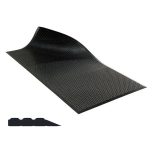 Workplace mats
Anti-fatigue mats in standard and ESD versions for standing workstations.
To the guides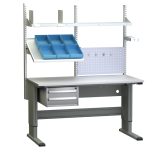 Lift table guide
Height-adjustable work surfaces for switching between sitting and standing.
Read guideFrequently asked questions
How thick should an anti-fatigue mat be?
For most standing workstations 12 to 20 mm is ideal. This thickness cushions noticeably without losing a stable stance. Thinner mats barely relieve strain, while much thicker ones can compromise stability.
What is the difference between an anti-fatigue mat and an ESD floor mat?
An anti-fatigue mat is a comfort and ergonomics mat that relieves legs and back. An ESD floor mat exists to dissipate static charge. There are dissipative anti-fatigue mats that combine both functions for EPA workstations.
Which material is most resistant to oil and chemicals?
Nitrile is the most resistant choice against oil, grease and many chemicals and suits workshop and production environments. PU foam is light and comfortable, rubber is robust, but both are less chemical-resistant than nitrile.
Set up the right standing workstation
Choose the right anti-fatigue mat, standard or ESD-dissipative, for your standing workstations.
Ergonomics first
Less fatigue and strain at standing workstations through targeted cushioning.
ESD variant available
Dissipative version for EPA areas in electronics manufacturing.
Verified safety
Bevelled edges and slip-resistant surfaces against tripping and slipping.
Selection help
We help you choose the right products; technical details are clarified with the manufacturer.