
NPN vs PNP - which sensor output fits your controller?
Whether a sensor switches ground or plus to the load in its active state is decided by NPN or PNP. This guide explains both output types, the difference between normally open (NO) and normally closed (NC), and how to wire them correctly to PLC and relay inputs.
To the guidesWhat do NPN and PNP mean on a sensor output?
NPN and PNP describe the output transistor stage of a 3-wire sensor. A PNP output switches the positive supply (+24 V) onto the load when active, so it is called sourcing. An NPN output instead switches the load to ground (0 V) and is described as sinking.
With PNP the load sits between the sensor output and ground; with NPN it sits between +24 V and the sensor output. The supply is identical in both cases: brown to +24 V, blue to 0 V, black is the signal output. Only the direction of the switched current differs.
Normally open or normally closed - what changes?
Beyond the transistor logic, the switching function defines when the signal is present. A normally open (NO) output turns on as soon as an object is detected. A normally closed (NC) output carries the signal at rest and switches off when an object appears.
NC contacts are chosen for safety when a broken wire must be detectable as a fault: if the signal disappears with no object present, the controller reports a fault immediately. For simple presence detection the NO output is usually enough.
- Normally open (NO): signal HIGH on object - standard for counting and positioning.
- Normally closed (NC): signal HIGH with no object - for the closed-circuit principle and wire-break monitoring.
- Antivalent (NO+NC): both signals in parallel, ideal for redundant evaluation.
- The switching function is freely combinable with either NPN or PNP.
How is the sensor wired to the PLC?
The decisive factor is the input type of the controller. A PLC input card is designed for either sinking or sourcing sensors. PNP sensors match inputs with a common minus (ground COM), NPN sensors match inputs with a common plus.
Wire the wrong type and the input stays silent or sits permanently HIGH. Check the data sheet of the input module before ordering. Many modern devices have inputs that support both variants simply by how the COM terminal is wired.
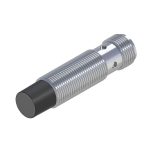 Choosing a proximity switch
Inductive, capacitive or optical - find the right sensor type.
To the guidesFrequently asked questions
Can I connect an NPN sensor to a PNP input?
Only if the PLC input supports both variants, or if you add an interface relay or coupling module. A pure PNP input will not recognise the ground-switching NPN signal otherwise.
How do I tell whether a sensor is NPN or PNP?
It is stated in the data sheet and usually on the type label. Three-wire sensors come in both variants with identical colour coding; only the switching direction of the black output differs.
What is the advantage of a normally closed (NC) output?
An NC output works on the closed-circuit principle. If the signal fails through a broken cable or a defective sensor, the controller detects this as a fault and moves to the safe state.
Are PNP sensors safer than NPN?
Both are equivalent. PNP is preferred in Europe because the signal line carries plus, so a short to ground on the line will not switch unintentionally. Safety depends mainly on the NO or NC function.
Looking for the right sensor output?
We supply inductive, capacitive and optical sensors in PNP or NPN versions with normally open or normally closed function to match your controller.
Matched to your PLC
PNP and NPN available for every input type.
Standard colour code
Terminal assignment marked to DIN and IEC.
24 V industrial
Robust 3- and 4-wire versions for the control cabinet.
Selection help
We help you choose the right products; technical details are clarified with the manufacturer.